
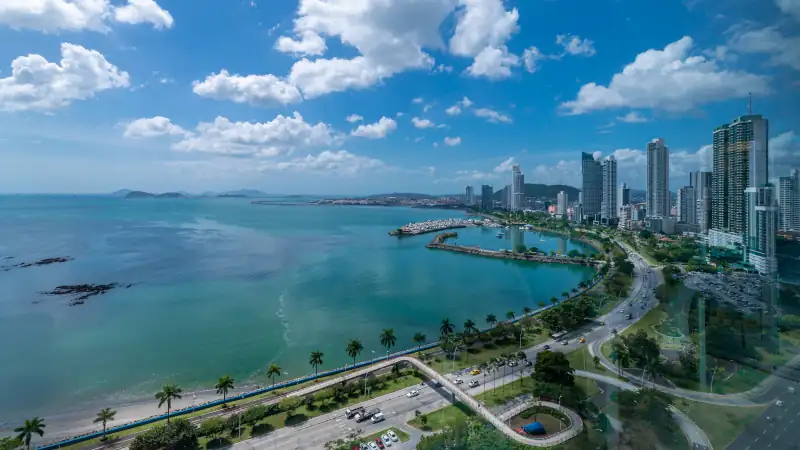
In the early 2000s, Panama was just starting its transformation.
The U.S. military handed back operations of the Panama Canal to the Panamanian government, and thousands of GIs who were spending their salaries in Panama City were relocated.
Until then, Panama hadn’t needed to promote tourism much. It was getting enough income from the canal and all those servicemen who were spending money in the country.
But suddenly, those servicemen and their salaries disappeared, and Panama’s economy slumped. It needed to create new industries quickly, and tourism and foreign business emerged as two powerful new growth engines.
Looking back, that period feels less like a setback and more like the beginning of a pattern Panama has repeated ever since: adapt quickly, attract global capital, and reposition itself for the next wave of growth.
Spotting A Gap In The Market
In 2002, a prominent developer in Panama City asked me what kind of project would appeal to Americans.
Kathleen and I had been active in the market for a couple years by that point, mostly looking for resale opportunities for investors. However, retirees had started to come to Panama…
All they could find in terms of property inventory was oversized apartments in desirable neighborhoods in the city—great for wealthy Panamanians but too large and expensive for the new wave of retirees, investors, and expats.
The only small apartments in those areas, if you could find them, were in older buildings without amenities.
My suggestion to the developer was to build one-bedroom apartments that could be rented out short-term—affordable and easy to manage. Smaller properties work better for investors and retirees whether they live in the apartment part- or full-time.
The Right Idea At The Right Time
Six months later, the developer showed me plans for a 200-unit tower on Avenida Balboa—one of Panama City’s most important thoroughfares. The building was in a prime location with ocean views that couldn’t be blocked. Every unit was a one-bedroom with modern layouts and finishes.
The timing was perfect. It was exactly the kind of project that fit the city’s new growth cycle. Panama was seeing a surge in foreign visitors and investment as the country came out of an economic downturn that started in 2000.
New Demand And New Buyer Profiles
The government also started incentivizing international companies to relocate to Panama, and many did, establishing their regional headquarters here.
Others came and started new businesses from scratch in Ciudad de Saber (City of Knowledge), then Panama Pacífico.
The banking industry also expanded as Panama was seen more and more as a safe haven destination.
These businesses brought in working expats who wanted high-quality, newly built places to stay… but didn’t want or need a 5,000-square-foot, four-bedroom apartment.
Those one-bedroom units on Avenida Balboa would eventually fit the bill for many potential owners and renters… but as the first of their kind in the market, the developer was taking a risk.
To reassure foreign buyers, he created a rental management company specifically for the building. It offered turn-key management for buyers who wanted flexibility in how they generated income.
That sealed the deal for many of the early buyers, including me.
Investing Before The Crowd
We reserved a unit off-plan in 2003 knowing that we could get a mortgage for the balance when the building was completed. The projected rental income would more than cover the mortgage payment and other expenses.
While the building sold well, it had more than 200 units, so it took some time for the developer to get all the pre-sales required for the bank to release the construction loan.
The building was completed in early 2007. By then, Panama’s market had exploded. Our unit was worth nearly double what we’d paid.
Many buyers flipped immediately… We decided to furnish and rent instead. We believed in the short-term rental potential of the apartment and the long-term stability in the Panama real estate market.
That proved to be the best choice for us long-term. The first year brought a 16% net yield—exceptional by any standard.
Tourism was rising, and the hotels hadn’t kept up with demand. Rooms were scarce, meanwhile business travelers, retirees, and expats needed places to stay. Short-term rentals did well.
When we moved to Panama in 2008, we used the apartment ourselves for a couple months during our transition while we looked for an apartment big enough for the entire family. This personal use was another unexpected benefit.
Adapting To A Changing Market
By that time, the hotel industry had caught up with construction of new hotel rooms, and regulations eventually shifted the short-term rental landscape. A law passed in 2012 outlawed rentals of less than 45 days.
We pivoted to a long-term rental strategy. Our first tenant stayed for more than five years, giving us steady income with minimal hassle.
A couple years and renters later, we turned the apartment into our pied-à-terre in Panama City when we became empty-nesters and had completed our beach house on the Pacific coast.
Why Panama City Still Attracts Global Buyers
Today, Panama City is Central America’s commercial center. It’s easy to reach and built for modern living, with high-quality real estate, world-class health care, American-style shopping, and solid infrastructure.
While prices are no longer early-stage cheap, demand is resilient, supported by a steady flow of foreign buyers looking for yield and livability.
Just as in the early 2000s, the city continues to evolve. New neighborhoods, infrastructure projects, and shifting global trends are creating fresh opportunities for those paying attention.
The Takeaway
Buying a property that offers options for how to make money gives you flexibility for your real estate portfolio.
This particular apartment could have been sold when completed for a nice profit. It generated good rental returns as both a short-term and long-term rental. It also worked well for us personally both when transitioning to Panama and as empty-nesters.
The value has gone up over the years and is now probably worth double what we paid for it. More importantly, it has delivered consistent cash flow, lifestyle benefits, and long-term exposure to a market that has repeatedly shown its ability to adapt and grow.
And in markets like Panama City, those cycles of change are often where the most interesting opportunities begin.
Stay diversified,

Lief Simon
Editorial Director, Global Property Advisor